
Code of the West
Our Story
My stepdad, Dan, asked me one day if I knew how to ride a motorcycle. I said no.
He put me on a dirt bike.
“One down, four up. Don’t hit the power band.”
I immediately hit the power band, flipped the bike, and burned my leg on the exhaust. Dan suggested I try the four-wheeler.
The people behind the drawings
Dan was a cowboy, and he was deliberate about teaching me. He still is. Often, his way of teaching involved putting me into something I hadn’t done before and giving me a chance to find out what I could do. It was hard to learn that way. Understanding what he was trying to give me took considerably longer.
My dad was an over-the-road truck driver. I spent much of my early childhood alongside him, picking things up by watching and working. When my mom and I moved to Idaho, the lessons continued in a different landscape. You learned to think about what might happen if the truck broke down in winter. You learned that being needed meant there was work to do.
Those are some of the people and experiences behind the cowboys I draw.
I’m Chris Hunt. I’ve spent my working life drawing and telling stories—in comics, commercial illustration, and eventually Code of the West. I created CARVER: A Paris Story, illustrated for companies including Filson, and served as art director at Black Rifle Coffee. The work took different forms, but the things I’d grown up with kept finding their way into it.
Drawing it out
Code of the West began as I was trying to make sense of those things for myself.
I saw people becoming more disconnected from one another. I felt some of that drift in my own life. Drawing was something I knew how to do, so I began there: cowboys, familiar sayings, and the expectations I’d grown up around. Putting them on paper gave me a way to examine what they meant and whether I was living up to them.
The writing grew alongside the drawings. Eventually, it became a book.
I keep coming back to courage because so much depends on it. Keeping your word can cost you. Taking responsibility can be uncomfortable. Sometimes speaking honestly means risking a relationship; sometimes it means caring enough about that relationship to have the conversation.
A code has to be useful in those moments. It has to leave room for judgment, for mistakes, and for learning something that changes your mind. I’m still doing all three.
Over time, people far beyond the West began finding themselves in the work. They brought their own experiences to it—people who had taught them, promises they were trying to keep, things they hoped to pass on.
That conversation is part of Code of the West now, too. The drawings, the writing, and the things we make are ways of keeping it going. I’m interested in what we can carry forward, and what we have to do ourselves if we want it to survive.
Twenty-five years later
It took me years to understand what Dan was doing. Sometimes I thought he was being cruel, or getting a laugh out of watching me struggle. There was certainly some laughing.
But he understood how much of a thing you could only learn once you were in it. You could prepare, ask questions, imagine everything that might go wrong. Eventually, something would happen that your preparations hadn’t accounted for, and you would have to respond. Waiting until you felt ready could become its own way of never starting.
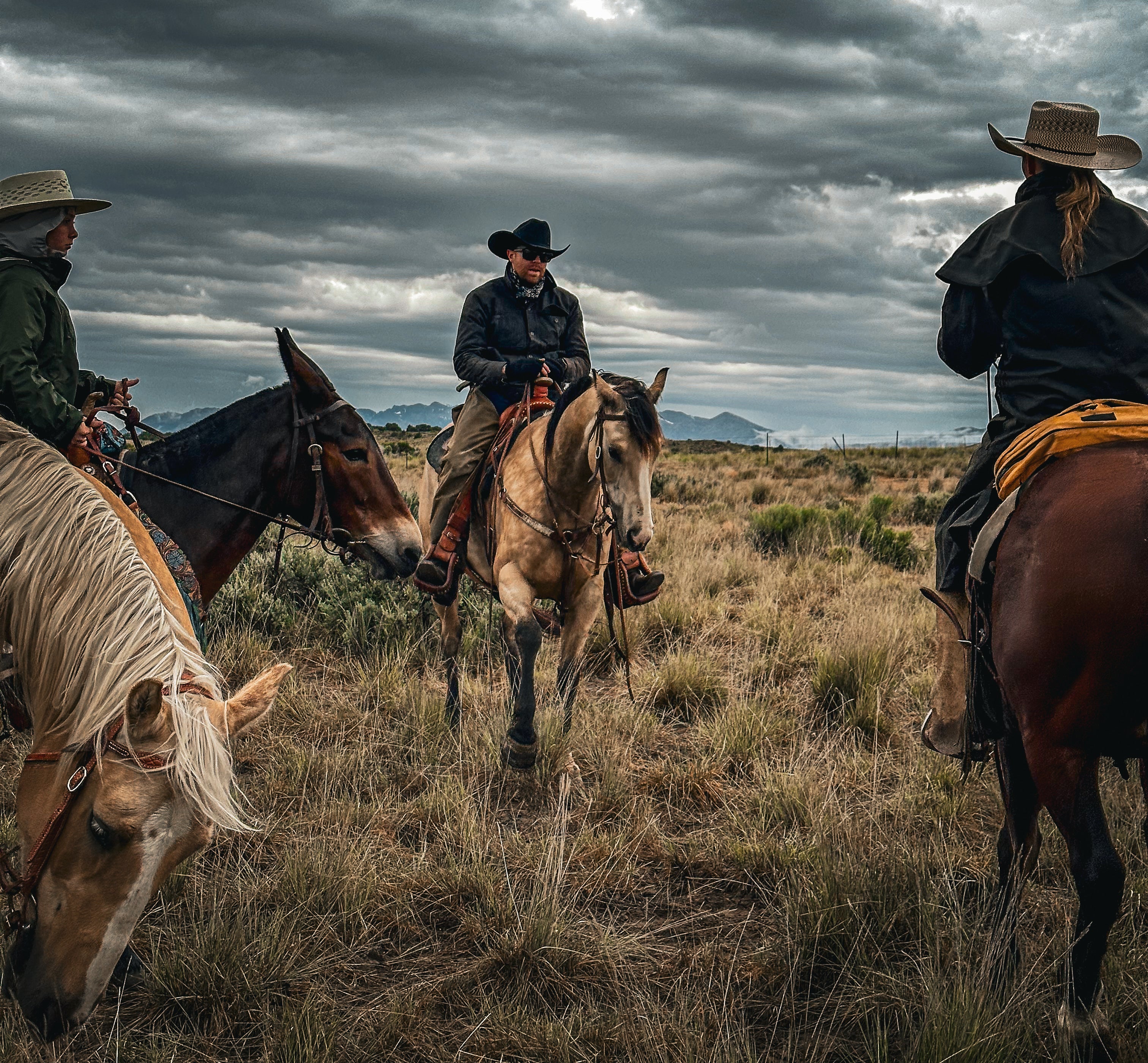
Twenty-five years after Dan put me on that dirt bike, I was at my second branding, sitting in a saddle before a roundup and cattle drive. I was about to ride a horse for the first time.
My instructions were to keep its head up. If it took off, I was told to turn its head so it ran in a circle until it was too tired to keep going.
That was what I had to start with.
Conversations
More about the life and ideas behind the work.
Chris Hunt Wants to Know: What Would You Hold Onto, Even If It Cost You Everything?
A candid conversation about moral frameworks, AI and sovereignty, work and survival, creativity and identity—and the questions that open a life back up.
“If you don’t consciously choose your framework, you’re just cast on the wind.”Read at Huckberry
Code of the West: An Artist’s Guide to the Cowboy Way
The landscape that formed Chris, the quiet expectations he absorbed there, and why consequence may be the clearest teacher we have.
“You can’t negotiate your way out of the consequences of reality.”Read at Boot Barn
Drawing the Code: Chris Hunt on the Cowboy Ethic
A conversation about ordinary courage, sovereignty without isolation, and why a code has to work when the decision gets difficult.
“Without a code, you don’t have a decision matrix. You’re winging it.”Read the Q&A